Repurposing
The Content You Write Is Disappearing: Why Great Writing Deserves a Second Life
Blog posts, newsletters, and book chapters are written with real craft — and then they disappear. Here's the case for giving every piece of written content a second life in the format where most people actually consume content in 2026.
Overview
TL;DR: Blog posts, newsletters, and book chapters are written with real craft and then vanish. This is the case for giving every piece of written content a second life as video — the format where most people actually consume content in 2026.
You spent four hours on that piece. You researched it. You went through two drafts. You found the right framing, built the argument properly, included the data points that made it credible. You published it.
And then it disappeared.
Not immediately — there was a brief moment of traffic, a spike of shares, maybe some replies. Then the algorithm moved on. The email was archived. The post fell off the feed. And the work you put into it — the thinking, the research, the structure — went with it.
This is the normal lifecycle of written content in 2026. It is also one of the most significant waste problems in modern content production.
The Lifecycle Problem
Written content is designed for a single distribution channel. A blog post lives on a website. A newsletter lives in an inbox. A book chapter lives in a bound volume. Each format has its own discovery system — Google search, email delivery, bookstore placement — and once that distribution event happens, the content's reach is largely determined.
The result is that most written content has a first life and no second life.
The first life is the publication event: the post goes live, the email sends, the book releases. Traffic spikes. Engagement happens. The content does what it was built to do.
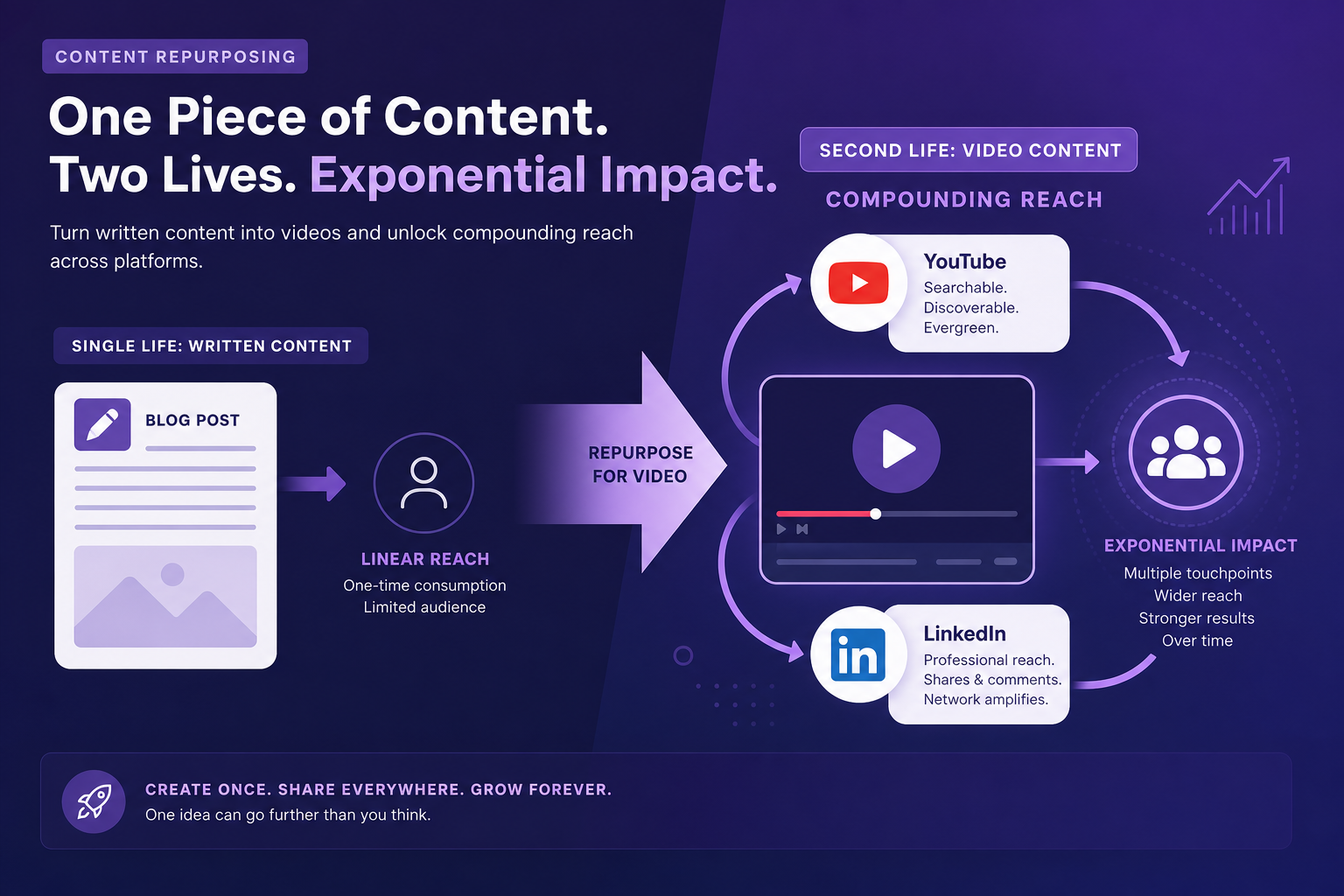
The second life — the extended discovery, the compounding reach, the ongoing audience the content could be building — almost never happens, because no one moves the content to the platforms where ongoing discovery occurs.
Consider what "ongoing discovery" means in 2026:
1. YouTube surfaces videos based on search queries and viewer behavior — permanently. A video published three years ago can rank for a search performed today.
2. LinkedIn serves native video to professional audiences at organic reach levels that text posts no longer achieve.
3. Podcast feeds are searched and browsed by listeners specifically looking for topics, not just shows.
4. Instagram Reels and TikTok surface content based on interest signals, not recency.
None of these channels are accessible to a text-only publishing workflow. The content that would perform well in each of them — the analysis, the argument, the insight — is sitting in blog archives and newsletter issues and book chapters, waiting for a packaging decision that never gets made.
Three Creators Who Feel This Most Acutely
The Finance Newsletter Writer
You spend 5–6 hours on a serious piece of market analysis. It goes to 4,000 subscribers. 38% open it. Your 10 best pieces — the ones where you got the call right, where the thesis was original, where readers replied saying "this changed how I think about it" — live in your archive, searchable only by your existing subscribers.
Meanwhile, YouTube is full of finance channels where people are searching for exactly the topics you've analyzed in depth. They won't find you. They're searching for videos.
The analysis you've already done is worth distributing on the platforms where new audiences are actively looking for it. The packaging is the only thing stopping that from happening.
The Marketing Agency
Your clients have content libraries — 50, 100, 200 published blog posts representing years of writing investment. Every post was a production involving a strategist, a writer, an editor, and a review cycle. Most generate steady but modest organic traffic and haven't been touched since they were published.
Meanwhile, every agency pitch deck includes a video strategy slide. Every client asks about video ROI. Every client's competitors are appearing in LinkedIn feeds with video content. The gap between "we should be doing video" and "we are doing video" exists entirely because no one has a production workflow that closes it affordably.
The content already exists. The packaging is the only thing stopping the video strategy from being operational.
The Nonfiction Author
You wrote 70,000 words. The launch was a success by some measures — bestseller list, podcast appearances, strong early reviews. Three months later, book discovery has returned to background levels. Amazon's algorithm surfaces it to buyers who are already looking; the book is not actively reaching readers who don't know to look for it.
Meanwhile, YouTube's search index will surface content about your book's topic to every person who searches that topic for the next five years. A video about your book's central argument — produced from the introduction you already wrote — would appear in those searches permanently.
The thinking is already done. The packaging is the only thing stopping the book from being discovered by the people most likely to benefit from it.
The Common Thread
Three different creators. Three different formats. Three different industries. One structural problem: written content is packaged for one channel and never moved to the channels where ongoing discovery happens.
The solution in all three cases isn't to produce more content. It's to give existing content a second life in the format — video — that reaches the platforms where new audiences are found.
The content is already good. In many cases, it's better than most video being produced on the same topics. The writing is done. The research is done. The argument is structured.
What's missing is the packaging.
What a Second Life Looks Like
When a piece of written content becomes a video, the lifecycle extends:
Day 1 — Text Only: Publication spike · Text + Video: Publication spike + video published
Week 1 — Text Only: Traffic declining · Text + Video: Video gaining initial views
Month 1 — Text Only: Steady low traffic · Text + Video: Video indexed in YouTube search
Month 6 — Text Only: Occasional referral traffic · Text + Video: Video accumulating views via search
Year 1 — Text Only: Minimal activity · Text + Video: Video still being surfaced in searches
Year 2 — Text Only: Archive · Text + Video: Video still generating discovery
The video isn't a replacement for the original content. It's an extension that connects the content to a second discovery system — one that operates continuously rather than spiking once and fading.
For finance newsletters, this means new subscribers finding you through YouTube search years after a piece was written. For agencies, it means client content generating LinkedIn impressions every week rather than just at publish. For book authors, it means new readers finding the book's ideas two years post-launch.
The Production Barrier (And How It Fell)
The reason most written content never gets a second life isn't strategic — most creators and content teams understand the value of video in theory. The reason is production cost and friction.
Video production has historically been expensive ($800–$4,000 per professional video), slow (days to weeks per piece), and skill-dependent (requires filmmaking, editing, or motion design skills most writers don't have).
These constraints meant that video production was rationed. Only the most important pieces got converted. The rest stayed in the archive.
In 2026, the cost structure has changed materially. AI video tools convert written content to professional video in 15–45 minutes at $4–$8 per render. No filming, no editing software, no production team. The template-based output is professional enough for publication on YouTube and LinkedIn without additional production work.
The production barrier that kept written content from getting a second life is largely gone. The question now is whether you build the workflow to take advantage of that.
Building the Workflow
The minimal viable workflow for giving content a second life:
1. Identify the pieces worth converting — high-traffic blog posts, best newsletter issues, strongest book chapters. You're looking for content with clear argument structure and standalone value.
1. Open Article Video Studio — articlevideostudio.com. Paste the URL or text of the piece.
1. Choose a template that matches your content type and brand: - Finance/analytical: Nightfall or Gridcraft - Business/educational: Gridcraft or Chronicle - Story-driven or narrative: Nightfall - Step-by-step or framework: Geometric Explainer - Bold/contrarian: Spotlight
1. Set your narrator voice and save it as your standard choice.
1. Generate, review, export — 20–40 minutes per video.
1. Publish to YouTube with a search-optimized title (the searchable question your content answers, not the original post title). Embed in the original post. Post to LinkedIn as native video.
1. Repeat — consistently, over time.
The compounding happens through consistency. One video is a test. Ten videos is a presence. Fifty videos is a discovery system.
Frequently Asked Questions
How do I prioritize which content to convert first?
Start with the content that performs best in its original channel — your highest-traffic blog posts, most-opened newsletter issues, or the chapters from your book that generate the most reader commentary. High-performing written content tends to perform well as video for the same reasons: it addresses questions people actually have, it's well-structured, and it delivers genuine value.
What if some of my best content is behind a paywall or subscriber-gated?
Create a public "preview" version that captures the thesis and key argument without the full detail. The video positions the full piece (or the book, or the paid newsletter tier) as the place to get the complete treatment. Gate the depth; make the argument public.
How do I handle content that's time-sensitive or has been superseded?
Update it before converting. If the data has changed or the argument has evolved, spend 20 minutes updating the piece before generating the video. An updated version of an existing piece is faster to produce than a new piece and benefits from the original structure you already built.
Do I need a large following before starting?
No — and this is one of the structural advantages of video over newsletter growth. YouTube surfaces content based on topic relevance before it considers channel size. A new channel publishing well-titled, high-quality finance content competes on the same footing as established channels in search-driven discovery. Starting before you have an audience is the right approach, not a reason to wait.
What's the difference between repurposing and just posting the same thing twice?
Repurposing means adapting content for a different channel's format, context, and discovery mechanism. A newsletter issue posted as text on LinkedIn is the same thing twice — same format, similar platform. A newsletter issue converted to video and published on YouTube is genuinely different: different format, different platform, different discovery system, different audience behavior. The underlying thinking is the same; the packaging is different. That difference is what enables the second life.