Use case
What Your Finance Subscribers Want to Watch: Turning Your Market Breakdown Into a 3-Minute Video
Finance newsletter writers produce market breakdowns their subscribers love to read. Here's how to convert that same analysis into a 3-minute video that reaches new audiences on YouTube and LinkedIn.
Overview
TL;DR: Your subscribers already love reading your market breakdowns. Here's how to convert that same analysis into a 3-minute video that reaches new audiences on YouTube and LinkedIn.
Your subscribers open your newsletter because they want your analysis. They're busy people — they chose your take over the hundreds of other finance opinions in their inbox. That's the highest form of trust a reader can extend.
Now consider what those same people are doing the other 23 hours of the day they didn't spend reading your newsletter. They're on LinkedIn scrolling while commuting. They're watching YouTube at 1.5x speed during lunch. They're in the format where content comes to them, not the format where they have to seek it out.
You're not reaching them there. Not because your thinking isn't good enough. Because you've never packaged it in the format those platforms require.
The Format Difference Between a Newsletter and a Video
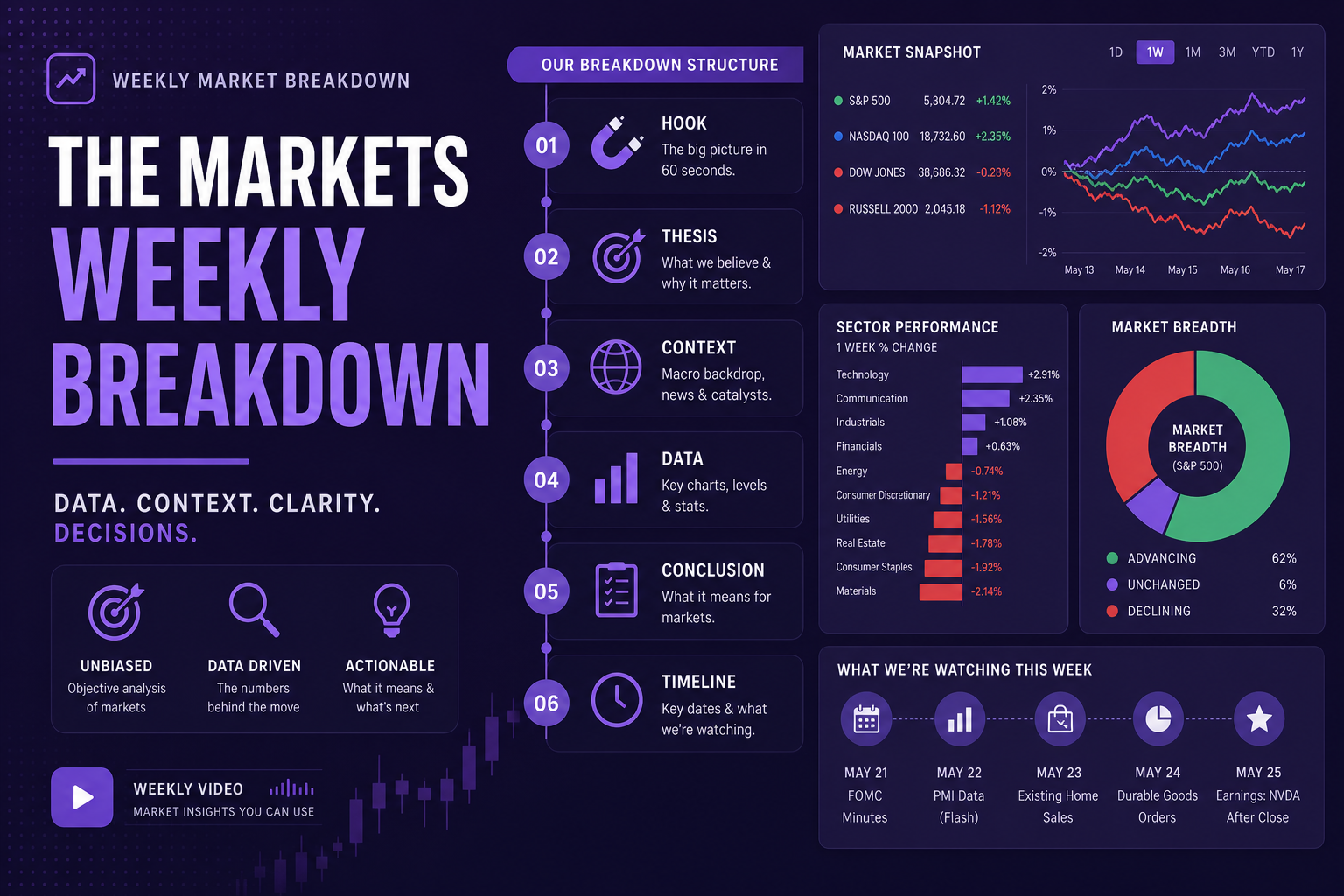
A great market breakdown newsletter usually has this structure:
1. Opening hook: an observation, data point, or question that frames the piece
2. Context: what happened and why it matters
3. Analysis: your thesis — the specific argument or interpretation
4. Data: the numbers, charts, or comparisons that support the thesis
5. Implication: what this means for investors, markets, or the macro picture
6. Call to action or next piece: what to watch, what's next, where you're focused
That structure — hook, context, analysis, data, implication — is also the structure of a professional financial news segment. Your newsletter isn't just a newsletter. It's a broadcast script waiting to be produced.
What a 3-Minute Finance Video Actually Looks Like
Three minutes is the optimal length for LinkedIn and a reasonable intro length for YouTube (where longer pieces with depth also perform well). At standard narration pace (~150 words per minute), a 3-minute video is roughly 450 words of source content.
Most market breakdown issues are 500–1,500 words. That means you're either using the first 450 words directly, or the AI tool condenses the key points across the full issue.
When you run a market breakdown through Article Video Studio, a typical 3-minute output looks like:
Opening hook — Duration: 20 sec · What's On Screen: Title card with the central thesis
Context — Duration: 35 sec · What's On Screen: Narration + contextual visual (market chart, relevant image)
Core data point 1 — Duration: 30 sec · What's On Screen: Data graphic overlay with the key number
Analysis / your take — Duration: 45 sec · What's On Screen: Narration-forward scene with relevant visual
Core data point 2 — Duration: 25 sec · What's On Screen: Data graphic overlay
Implication — Duration: 30 sec · What's On Screen: Clean scene framing your conclusion
Call to action — Duration: 15 sec · What's On Screen: Newsletter CTA with subscription link
That's 3 minutes, 6–7 scenes, and the full arc of your thesis — produced from your existing writing in about 20 minutes.
Template Selection for Finance Breakdown Content
Visual style signals authority in finance video. Choosing the right template for your content type matters:
Nightfall — dark glass panels with neon-tinted data graphics Best for: Macro commentary, market commentary, rate and yield analysis, premium positioning Feel: Bloomberg terminal meets premium financial media. Signals that you're serious.
Gridcraft — editorial grid layout, clean and structured Best for: Company breakdowns, sector analysis, framework-style thinking, weekly roundups Feel: Analytical, organized, high-information-density. Signals rigor and structure.
Chronicle — document-forward with data emphasis Best for: Deep research pieces, earnings analysis, long-form thesis content Feel: Academic-credible but visually compelling. Signals depth and thoroughness.
Spotlight — bold kinetic typography Best for: Big calls, contrarian takes, breaking analysis Feel: High-energy, opinion-forward. Use when you want maximum reaction.
Most finance newsletters should stay in Nightfall or Gridcraft for regular issues. Reserve Spotlight for your most confident or contrarian pieces.
The Subscriber Relationship Carries to Video
Something finance writers underestimate: subscribers who follow you on both email and video develop a deeper relationship with your brand than those who only read.
When someone reads your newsletter and then watches your video — even on the same content — they're consuming your analysis in two different modes. The video creates a parasocial element (they hear your voice through the narrator, they're in the visual rhythm of your brand) that text alone doesn't build. That depth translates to higher open rates, higher paid conversion, and lower churn.
The readers who engage with your video tend to be your most active readers. They're not just passively consuming — they're actively interested in your thinking across formats.
Writing the LinkedIn Caption That Gets Your Video Seen
The caption on your LinkedIn video post is the conversion lever. Most writers either write too much (a full summary of the newsletter) or too little ("New video out!"). The format that works for finance content:
Line 1: The thesis or the most interesting claim. Make it specific. Not "I look at the bond market" but "I think the bond market is pricing in the wrong recession probability."
Line 2–3: One sentence of supporting context. One striking data point or observation that makes the claim credible. Not three paragraphs — one sentence.
Line 4: The invitation. "3-minute breakdown below." or "Watch and tell me what I'm missing." The invitation language that generates comments (which feed LinkedIn's algorithm) includes direct challenges: "I'm probably wrong about [X]. Here's the argument." People cannot resist commenting on that.
Final line: Newsletter CTA. "Full analysis in this week's newsletter — link in comments." (Put your Substack link in the first comment, not the caption — LinkedIn buries posts with external links in the caption itself.)
Posting Schedule for Newsletter + Video Together
The two formats compound each other when timed correctly:
Option A: Same-day release: Publish your newsletter on Tuesday morning. That afternoon or evening, post the video to LinkedIn and YouTube. Subscribers who already read the newsletter see the video as a "second take" on the same content — some will repost because they liked the issue and the video is shareable. New viewers on LinkedIn and YouTube find the video first and subscribe.
Option B: Video as preview (Tuesday video, Wednesday newsletter): Post the video first — it's a 3-minute thesis statement. The next morning, publish the full newsletter. Use the video caption: "My full breakdown goes to newsletter subscribers tomorrow." This creates a subscriber-upgrade incentive for people who watched the video and want the full piece.
Most finance writers who test both options prefer Option B because it uses the video actively to drive newsletter conversions, not just passively.
Frequently Asked Questions
What if my market breakdown has charts I built myself? Can those appear in the video?
Yes. In the Article Video Studio editor, you can swap any scene's image with your own chart. Upload the chart image and place it in the relevant scene — it appears in the frame alongside the narration. This is especially valuable for original data visualizations that distinguish your analysis.
My analysis is very specific — will the AI narrator convey technical terms accurately?
Article Video Studio narrates your text directly — it doesn't rephrase or simplify. Terms like "duration risk," "basis points," "QE tapering," or "inverted yield curve" appear exactly as you wrote them in the narration. The AI doesn't dilute financial language.
How long should I wait before converting a timely piece to video?
Timely content (earnings reactions, rate decision analysis) should be converted immediately — within 24–48 hours of publishing while the topic is still being searched. Evergreen content (how-to pieces, framework explanations) can be converted any time because they're searched independently of when they were written.
Should I include my performance track record in the video?
If you have a track record you publish in the newsletter, including a brief reference in the video builds credibility with new viewers. Keep compliance in mind — for regulated advisors, apply the same disclosure standards you use in the newsletter.
What if my audience prefers reading to watching?
They probably do — that's why they subscribed to your newsletter instead of following a YouTube channel. The video isn't for them. It's for the audience that doesn't know you yet, who discover you through YouTube search or LinkedIn recommendation, and then convert to newsletter subscribers. The two formats serve different stages of the audience relationship.