Behind the scenes
The 2008 Financial Crisis, Explained in Four Steps with Stick Figures
The whole thing nearly collapsed, and it started with a house. We stripped the 2008 crash down to four steps you can follow with a row of stick figures and a few charts — a documentary-style Remotion short.
Overview
The whole thing nearly collapsed. It started with a house.
In 2008 the global economy came within a whisker of collapse — banks failed, markets crashed, and millions of people lost their homes. It sounds impossibly complicated. It isn't. This short strips the crisis down to four steps you can follow with nothing but a row of stick figures and a few charts.
The four steps
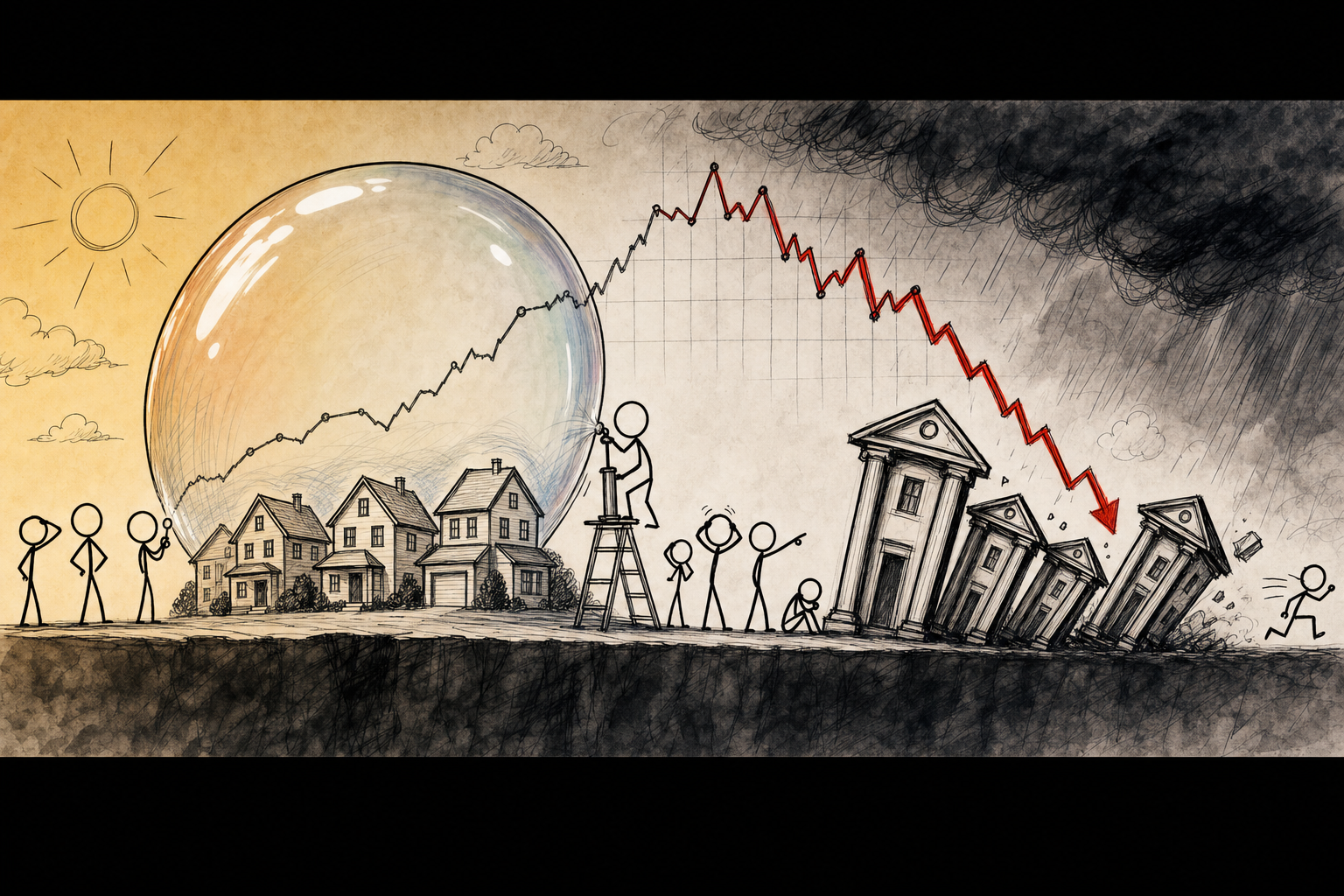
Step 1 — The housing bubble. For years, house prices did just one thing: they went up. And if prices always rise, a home looks like a sure bet. So everyone piled in — buyers, banks, investors. On screen, a single house floats inside a bubble that inflates bigger and bigger while its price tag ticks upward and "SOLD" signs pop onto every house in the row. The more people bought, the higher prices climbed.
Step 2 — The instruments. The real fuel came from Wall Street. Banks took thousands of individual home loans, bundled them into a single package, and sold slices of it as bonds — mortgage-backed securities. We show it literally: a stack of "LOAN" papers is swept together into one glowing box, a green AAA rating slams down on it, and it's snapped up by investors around the world. Rated safe as gold.
Step 3 — No due diligence. There was one problem. To keep that machine fed, lenders needed more and more mortgages, so they stopped asking questions. No income? No job? No down payment? A giant red APPROVED stamp comes down anyway — again, and again, and again — while a banker who never looks up builds a pile of rubber-stamped loans. As long as the loan could be bundled and sold off, nobody checked whether it would ever be paid back.
Step 4 — The crash and the bailout. Then homeowners began to default. The bubble bursts in a flash of shards, the price chart reverses and plunges red, and those "safe" bonds turn toxic overnight. Bank towers lean and topple like dominoes as foreclosure signs go up. To stop the entire system from going down with them, the government steps in with a bailout — hundreds of billions of taxpayer dollars, poured out of the Treasury to catch the banks as they fall. $700 billion.
How we made it
Where our other shorts lean cinematic, this one leans like a documentary whiteboard. Some of the craft:
- Diagrammatic, not mythic: cool slate-night backdrops, money-gold and crash-red accents, and clean primitives — houses, a price chart, a bond box, a loan desk, bank towers, and a columned Treasury.
- Four beats, four camera setups, each timed to one narration segment on a single continuous clock so the visuals and the voice never drift apart.
- A plain-spoken narrator: the same warm voice from our myth series, dialed back to a steady, measured documentary read, so the ideas are allowed to land.
- Everything is code — built entirely in Remotion (React), with no stock footage and no AI-generated video. Voice and sound effects are generated with ElevenLabs, and it ships in both landscape (1920×1080) and portrait (1080×1920) from the same responsive composition.
The takeaway
A crisis built on one simple idea — prices always go up — taken much too far. The point of the film isn't to assign blame; it's to prove that even the most complicated story can be made clear when you show it instead of explaining it.
Great writing deserves an audience, and complex ideas deserve to be understood. If you can explain the 2008 crash with stick figures, you can turn anything into a video worth watching. Turn yours into one at articlevideostudio.com.
Frequently Asked Questions
Who is this guide for around 2008 financial crisis explained?
It is designed for written-first creators and teams who already have source material and want a repeatable path into video rather than a prompt-only workflow.
Does this help with subprime mortgage crisis explainer video?
Yes. Each article is written to help you turn one content asset into multiple formats while keeping the original message intact.