Strategy
What Happens to Your Book After the Launch: Video as a Long-Term Discovery Engine
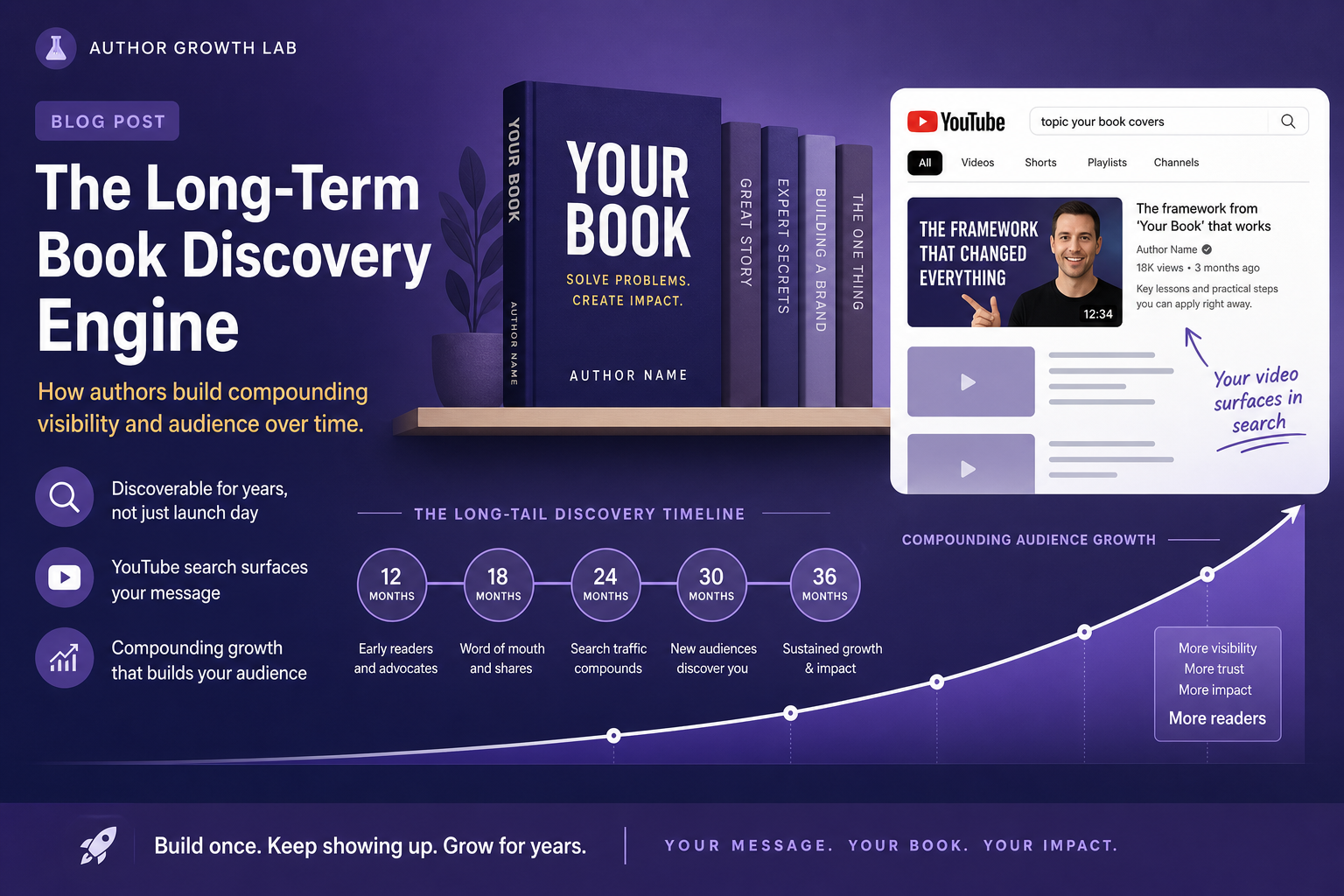
Most book sales don't happen at launch — they happen in the 12–36 months that follow, when the right person finds the right book at the right moment. Here's how video keeps your book discoverable long after the launch window closes.
Overview
TL;DR: Most book sales happen in the 12–36 months after launch, not during it. Video keeps your book discoverable long after the launch spike fades — here's how to build that long-term discovery engine.
Here's the honest picture of how most nonfiction book launches go:
Weeks 1–3: Pre-orders activate. Your network shares your posts. You do interviews. Sales spike. You may hit a bestseller list if the launch is well-coordinated.
Weeks 4–8: The spike fades. Attention moves on. Reviews slow down. The publisher moves to the next title.
Month 3–12: Steady but modest sales, mostly from organic search and word of mouth. You're grateful for every one, but the engine is quiet.
Month 12+: The book is still selling. Somewhere, someone is reading it for the first time and it's changing how they think. But you don't know who they are or how they found it, because the discovery happened without you.
Most author marketing is front-loaded into a 3-week window before and after launch. Most book discovery — especially for nonfiction with lasting relevance — happens in the 12–36 months that follow. The launch is a spike. The long tail is where most readers come from.
The question is: what builds that long tail?
How Readers Find Books After the Launch Window
The channels that drive long-tail book discovery:
Amazon recommendation engine — How It Works: Surfaces books to buyers based on prior purchase patterns · Author Control: Low
Goodreads discovery — How It Works: Readers find books from friends' shelves and reviews · Author Control: Low–medium
Word of mouth — How It Works: Readers recommend to other readers · Author Control: Low (you can seed this)
Press coverage — How It Works: Reviews, features in publications · Author Control: Low (post-launch)
Podcast appearances — How It Works: Host's audience discovers you · Author Control: Medium (requires outreach)
YouTube search — How It Works: Viewers search topic, find your video, click through to book · Author Control: High
LinkedIn organic — How It Works: Content reaches new professional audiences · Author Control: High
Your newsletter/website — How It Works: Ongoing audience building · Author Control: High
Google search (SEO) — How It Works: Author website or content ranks for topic searches · Author Control: Medium
Notice the pattern: the channels with the highest author control are the ones that require consistent content production. Amazon's algorithm does what Amazon's algorithm does. Word of mouth spreads when it spreads. But YouTube and LinkedIn are platforms where your own ongoing publishing directly determines your visibility.
A book with no ongoing video presence depends on channels the author can't control. A book with a consistent video strategy has a discovery engine the author operates.
Why Video Is the Best Long-Tail Discovery Format
YouTube is permanent. A video published in 2026 about your book's ideas will be surfaced in 2029 searches on the same topic. This is categorically different from social media posts, which disappear from visibility within 24–48 hours of publishing. The YouTube library you build around your book is a permanent search asset.
YouTube is intent-driven. Someone searching "how to build better habits" on YouTube is in the same mindset as someone who would buy a book about habit formation. The intent signal — what they're searching for — tells you exactly what problem they're trying to solve. If your video answers that problem and your book promises to solve it completely, the path from viewer to buyer is direct.
Video distributes ideas, not books. This distinction matters. Most post-launch marketing tries to promote the book itself — "buy [Book Title]." Video marketing distributes the ideas in the book, which creates an audience that comes to the book naturally. Someone who watches your thesis video for 5 minutes and finds the argument genuinely useful doesn't need to be persuaded to buy — they're already predisposed. The book is the obvious next step.
Video compounds across years. Books that have sustained YouTube presence — where the author has been producing consistent video about the book's ideas for 2+ years — often outperform their launch sales in years 2 and 3. The discovery surface grows larger every month. New videos cross-promote older ones. The YouTube algorithm learns to surface the channel to people interested in the topic. Each new video adds a permanent entry point for new readers.
The Content System That Builds Long-Term Discovery
This isn't about posting one video a year and hoping. It's about building a system that produces consistent output with sustainable effort.
Year 1 system: Chapter-by-chapter video content
The framework is simple: 6 video types from each chapter (detailed in the companion piece on this site). If your book has 10 chapters, you have 60 potential videos. At one video per week, that's more than a year of content from your existing book material — and you're not writing anything new.
The production workflow using Article Video Studio takes 30–45 minutes per video. At 4 videos per month, that's 2–3 hours of production time. This is what makes the system sustainable: the input required is far below what most authors assume.
Year 2 system: Response and expansion content
By year 2, you have data. You know which videos drove the most book purchases, which generated the most subscriber sign-ups, which questions viewers are asking in comments. Year 2 content responds to this feedback:
1. Answer the most common questions from Year 1 comments
2. Revisit the videos that performed best with deeper follow-up
3. Address the objections and pushback your thesis received
4. Expand ideas that turned out to be more valuable than you expected
5. Document what's changed or been updated since publication
This content is uniquely credible because it demonstrates real engagement with your audience. It signals that you're thinking about these ideas actively, not just promoting a static book.
Year 3+ system: Topic authority content
By year 3, if you've been consistent, your YouTube channel and LinkedIn presence have become independently valuable — not just as a marketing vehicle for the book, but as a content brand in your topic area. New readers discover you through the content and then find the book. Your content has become a front door for the book rather than an advertisement for it.
Setting Realistic Expectations
The compounding nature of video discovery means results are back-weighted. You won't see dramatic results from your first 10 videos. You may not see them from your first 30.
But here's what the data on YouTube channel growth consistently shows: authors who publish at least 2 videos per month for 12 months begin seeing meaningful inbound traffic from their content after roughly the 9–12 month mark. The first year is almost always a long build. The second year is where the results become obvious.
This is hard to internalize when you're accustomed to the immediacy of launch-week results. Book launches have fast feedback — sales rank, review count, bestseller list position — that gives you clear signals quickly. Video has slow feedback that builds over time and then compounds in ways that are genuinely hard to predict.
The authors who benefit most from long-tail video discovery are the ones who started before they needed it, built consistently even when early results were modest, and didn't stop when the immediate feedback was slow.
Staying Consistent Without Burning Out
The most common failure mode for author video content: over-producing at launch, then going silent.
Authors produce 10 videos in the launch month. The effort is intense. The immediate results feel disappointing relative to the work. They stop.
The way to avoid this is to design for sustainability from the start:
One video every 2 weeks is sustainable for most authors alongside their writing schedule. That's 26 videos per year — a meaningful library that grows without dominating your time.
Batch-produce quarterly. Pick 4 days per year, each dedicated to producing 6–8 videos. The rest of the year you're publishing but not producing. This separates the creative work from the scheduling and reduces decision fatigue.
Automate distribution. Schedule YouTube uploads in YouTube Studio. Schedule LinkedIn posts with a social scheduling tool. Once you have a batch of videos, the publishing is on autopilot for 6–8 weeks.
Reuse high-performing content. If a video performed significantly better than average, produce a follow-up, a deeper version, or a "6 months later" response. High-performing content tells you what your audience actually wants — give them more of it.
Frequently Asked Questions
My book is two years old. Is it too late to start video content?
No — it's actually a good time. Your book has reviews, a track record, and reader feedback you can incorporate into the content. An established book with new video content gets a second discovery wave. Some authors have seen book sales revive meaningfully after a year of consistent video content, even for titles that had been quiet for 18+ months.
How do I know which book ideas will perform best on YouTube?
Research what's already performing in your topic area. Search your book's main topics on YouTube and sort by "Most Views." The video titles that get the most views signal what the audience is actively searching for. Map your book's ideas to those search patterns.
Should I be worried about giving the book's content away for free?
No — and this is the most consistent finding across nonfiction authors who use content marketing seriously. Free content that demonstrates the quality of your thinking increases book sales, it doesn't replace them. Readers who watch 20 hours of your videos want the full, organized treatment of your ideas — that's the book.
What should I do when I run out of ideas from the current book?
By the time you've exhausted one book's content on video, you're probably working on the next one. The content calendar naturally transitions from Book 1 to Book 2. Authors who maintain ongoing video presences often use their video content to develop ideas that eventually become their next book — viewer questions, comments, and engagement surface the specific problems the audience most wants addressed.
Can I repurpose old podcast appearances or interviews into video content?
Yes. If you have recorded podcast appearances where you discussed your book's ideas, those can be converted into short-form video clips or produced as standalone content. The audio track from a podcast interview, combined with visuals from Article Video Studio, can produce a polished-looking video from content you've already created. This is a particularly efficient repurposing path for authors who do a lot of press.